I celebrated my first Mass on November 26, 1972. I did it using the rite then in force, the one created by Paul VI, whose author was the Freemason Annibale Bugnini. The Mass was In Spanish, of course, though the secret prayers of the celebrant survived in Latin.
The Latin Mass Leeds blog is here to raise awareness of the activity related to the Extraordinary Form of Mass (also known as the Traditional Latin or Tridentine Mass) in the Diocese of Leeds and to promote and publicize other issues of interest to traditionally minded Catholics. This blog has no official links with any other organisations.
Thursday, March 30, 2023
Very recent strong words from the Archbishop Emeritus of La Plata, Buenos Aires, Argentina
Tuesday, March 28, 2023
Poster Campaign in Rome
Text copied from Gateshead Revisited blog:
News from Rome! http://blog.messainlatino.it/2023/03/breakingnews-la-liturgia-tradizionale.html
PRESS RELEASE Starting this morning, and lasting for 15 days, several dozen billboards dedicated to the traditional liturgy will be posted near and around the Vatican. An organizing committee, whose members are participating in a personal capacity and who come from different Catholic entities (such as the blogs, Messainlatino and Campari & de Maistre, and the associations, National Committee on Summorum Pontificum and the St Michael the Archangel Association), wished to make public their profound attachment to the traditional Mass at a time when its extinction seems to be planned. They do so out of love for the Pope, so that he might be paternally opened to understanding those liturgical peripheries that no longer feel welcome in the Church, because they find in the traditional liturgy the full and complete expression of the entire Catholic Faith. “What earlier generations held as sacred, remains sacred and great for us too, and it cannot be all of a sudden entirely forbidden of even considered harmful” (Benedict XVI, Letter to the Bishops on the occasion of the publication of the Apostolic Letter Summorum Pontificum). The growing hostility towards the traditional liturgy finds no justification on either a theological or pastoral level. The communities that celebrate the liturgy according to the 1962 Roman Missal are not rebels against the Church. On the contrary, blessed by steady growth in lay faithful and priestly vocations, they constitute an example of steadfast perseverance in Catholic faith and unity, in a world increasingly insensitive to the Gospel, and an ecclesial context increasingly yielding to disintegrating impulses. For this reason, the attitude of rejection with which their own pastors are forced to treat these communities today is not only reason for bitter sorrow, which these faithful strive to offer for the purification of the Church, but also constitutes a grave injustice. In the face of this injustice, charity itself demands that we not remain silent: for “indiscreet silence leaves in error those who might have been instructed” (Pope St Gregory the Great, Pastoral Rule, Book II, chapter 4). In the Church of our day, in which listening, welcoming, and inclusion inspire all pastoral action, and there is a desire to build ecclesial communion “with a synodal method,” this group of ordinary faithful, young families, and fervent priests has the confident hope that its voice will not be stifled but welcomed, listened to, and taken into due consideration. Those who go to the “Latin Mass” are not second-class believers, nor are they deviants to be re-educated or a burden to be gotten rid of. The Organizing Committee (Toni Brandi, Luigi Casalini, Federico Catani, Guillaume Luyt, Simone Ortolani, Marco Sgroi) prolibertatemissalis@gmail.com
Saturday, March 25, 2023
A “rite” to reply.
I had been told beforehand that this diocese’s episcopal delegate for the traditional Mass, Fr. Michael
Hall, had been interviewed for March 19th.’s Sunday programme in a piece about
the Roche Rescript. (It is available here: Sunday - 19/03/2023 - BBC
Sounds at 5:10 into the programme). It was a short report and featured
Father Hall, a south of England You-Tuber, Austin Ivereigh and Cardinal Roche
himself.
The whole thing made for sad and
disturbing listening as Fr. Hall explained that he didn’t feel as if he could really
look to the Holy Father as his spiritual father because of things he had said
about traditional Catholics and that he felt as if Francis hates him and people
like him.
An internet search of remarks
made by the Pope about those attracted to the old Mass would certainly bear
this out. “Restorationism has come to gag the Council”; their problem is
“precisely their non-acceptance of the Council”; “Dogma and morality is always
in a path of development”; “You cannot do theology with a ‘no’ in front of it;
“Tradition is the living faith of the dead, for traditionalists it is the dead
faith of the living”; “'Self-absorbed neo-Promethean Pelagians”; “Traditionalists
safeguard the ashes of the past whilst ‘touting’ tradition as the guarantee of
the future”.
Thus, it seems we have been cast
as prostitutes looking for business.
Perhaps most tellingly on June 14th. 2022, the Jesuit publication America
reported, “Just last week, in a meeting with Sicilian clergy, Francis told the
priests that it wasn’t always appropriate to use “grandma’s lace” in their
vestments and to update their liturgical garb to be in touch with
current times and follow in
the spirit of Vatican II.”
These remarks were also echoed in the Sunday broadcast by Cardinal Roche who claimed that the theology of the Church has changed and that a distant priest no longer represents all people because now it is not only the priest who celebrates the liturgy but all those who are baptised with him.
The Cardinal
admitted that this was an enormous statement to make.
My understanding had been that
pastors were to ensure “the faithful were fully aware of what they were doing,
actively engaged in the rite, and enriched by it.” (Sacrosanctum Concillium.) In
anybody’s wildest imaginings this could not mean that they were to be eventually
regarded as concelebrants. Could it?
The enormity of the statement is
undeniable for nowhere in the documents of the Council have I ever seen or had
my attention drawn to such a statement. Is the Cardinal perhaps referring to
what Pope Francis above calls the spirit of the Council?
I am assuming that this “spirit”
permits the abomination of idol worship in the figure of the Pachamama?
Pachamama (Earth Mother) is a goddess revered by people of the Andes and is
also an Earth Mother in Inca mythology who is a fertility goddess who oversees
planting and harvesting and is able to cause earthquakes. As an ever-present
and independent “deity”, she apparently has the power to sustain life on earth.
The Holy Father with Pachamama in
the foreground in the Vatican gardens
Perhaps the spirit of the Council
is the permission for those living in irregular situations to avail themselves
of the reception of Holy Communion by way of a discursive footnote in the document
Amoris Laetitia. To me this makes a mockery of the heroic struggles made by people in irregular relationships both now and in the past to live up to the Teaching of the Church in regard to this matter.
I repeat, “The theology of the
Church has changed”, according to Cardinal Roche. Do we have evidence of this
statement yet?
Cardinal Hollerich SJ the Primate
of Luxembourg who is the Relator General of Pope Francis’ Synod stated with
regard to the Synod, “We must learn to cope with multiple expressions of faith.
Today one can no longer proscribe a single practice, nor can we as bishops.”
Spoken like a true liberal. I have been unable to ascertain the situation
facing the old Mass in Luxembourg.
This very much reminds me of
comments made to me by Bishop Terry Drainey a few years ago at the Oratory in
York. He said that there could be no problem if people genuinely worshipped God
by attending a Solemn High Mass or standing on a chair waving their arms in the
air. More likely to do the former myself, I couldn’t disagree with him. I know a lot of
good arm wavers and have known many Charismatics who were as devoted and
obedient to the traditional teaching of the Church as any traditionally
orientated Catholic I have known.
It has been pointed out countless
times by people far more intelligent than I am that the strength of the unity
of the Church is in its diversity and not in uniformity and rigidity. There are 24 Rites and Uses in the Church. Is
Cardinal Roche’s intention to kick these venerable Rites into line with his
vision of Nu-church with its new theology by picking them off one at a time
starting, say with the Ordinariate Use with the excuse that if they really want
to be Catholics they’ll have to start singing from the same hymn sheet?
It certainly looks as if what the
Pope and the Cardinal are saying is that the Traditional Mass, the
Extraordinary Form, is no longer compatible with the spirit of Vatican II.
In his slot on the Sunday
Programme Mr. Ivereigh said that it was very clear in the Pope’s letter to the
bishops that traditionalists represent a movement to undermine Vatican II. He
wishes not to suppress the old Mass but to regulate it by putting it back into
the hands of the bishops.
I wondered if this clip of Mr.
Ivereigh referred to Traditiones Custodes and not the Roche Rescript as the
rescript has done exactly the opposite to what the pope appeared to have
originally intended.
Cardinal Roche’s Rescript
snatches away the power of the bishops to “regulate” the celebration of Mass in
their respective dioceses according to the books of 1962. Cardinal Roche is as
keen to remind us of the Council as the Pope is to have us kowtow to its spirit
but the Council’s document Lumen Gentium (27) stopped the bishops from being
mere vicars or lackeys of the pope by stating, “bishops have the sacred right
and duty before the Lord…to moderate everything
pertaining to the ordering of worship.” To all intents and purposes Church
teaching from as late as the 1960s is now being sacrificed on the altar of the “hermeneutic
of discontinuity and rupture” in the mere name of the spirit of the
Council. Confusion reigns. Who is undermining the Council now? Goodbye to the
concept of collegiality.
Pope John XXIII who convoked the
Council said its primary purpose was that the sacred deposit of Christian
Doctrine be guarded and taught more effectively. At its close Pope Paul
VI said that John's great purpose had been achieved. There was apparently never
any intention of new theology.
In Traditiones Custodes
the Pope begins by stating, “Guardians of the Tradition, the bishops in
communion with the bishop of Rome constitute the visible principle and
foundation of the unity of their particular churches. Under the guidance of the
Holy Spirit through the proclamation of the Gospel and by means of the
celebration of the Eucharist they govern the particular churches entrusted to
them”.
He goes on to say that his
predecessors John Paul II and Benedict XVI granted and regulated the faculty to
use the Roman Missal edited by John XXIII in 1962 to facilitate the ecclesial
communion of those Catholics who feel attached to some earlier liturgical form.
In 2020 there was a consultation
of the bishops and apparently as a result of this “consultation” , the results of which, in our open Church, have never
been revealed, the pope imposed a list
of restrictions in Traditiones Custodes decreeing for example that there
should be no authorisation of establishing new groups and that no priest
ordained after the publication of that document should be allowed to offer the
traditional Mass without recourse to Rome for this permission. I wonder how
many priests have requested and been granted such permission.
Bishops as the guardians of tradition
were now free to dispense with permitting the celebration of Mass according to
the books of 1962 if they so wished. Some like Cardinal Cupich of Chicago and
others did use this document to axe Masses but by and large most bishops were
happy to allow the status quo to continue in their sees. Very strange if the bishop’s
consultation had hinted at widespread disobedience and sedition against the
Council. Liturgical peace was shattered in such places as old wounds were
reopened and now fester again.
Some bishops posed dubia and in
his responsa, Cardinal Roche added further restrictions saying for example that
celebrations of the 1962 Mass were not allowed to be advertised on parish
bulletins and newsletters.
Possibly in reaction to the fact
that the bishops had in effect generally ignored Traditiones Custodes it
came as no surprise when the Congregation for Divine Liturgy and Discipline of
the Sacraments published the shocking rescript in February of this year which
knuckled down on what had gone before it by further attempting to stamp out the
old Mass. Under canon 87 (i) a bishop, remember, a custodian of tradition whose
duty it is to moderate everything pertaining to the ordering of worship now had
the rug pulled from under his feet as this right in canon law was withdrawn Is the Code of
Canon Law so delicate that one Prefect can sweep it away so swiftly? The permissions
given by bishops in their own dioceses to their priests saying the old Mass in
their parish churches and chapels were nullified by the stroke of a pen. Bishops
were being expected to dust off their liturgical jackboots.
In one conversation I had with
Bishop Stock he told me that he knew well enough that there were no seditious
groups lurking in the wings to question and undermine the Council. Indeed, few
of the priests who offer the Mass in this diocese are even hardly old enough to
remember it and they all say the new Mass dutifully without murmuring or
rancour. Why should they? One Leeds parish priest told me that by celebrating
the old Mass privately it had enriched his experience of saying the new Mass
and deepened his understanding of it.
Perhaps Pope Benedict saw the
dangers of where the nebulous spirit of the Council was leading when as early
as 1990 he wrote, “The liturgical reform in its concrete realization has
distanced itself even more from its origin. The result has not been a
re-animation but devastation – they have produced a fabricated liturgy.” (Revue
Theologisches)
In 2000 in his Spirit of the
Liturgy, “Anyone who now advocates the continuing existence of this liturgy
or takes part in it is treated like a leper. All tolerance ends here. In doing
this we are despising and proscribing the Church’s whole past. How can one
trust her at present if things are that way?
He had already decried this
attitude in 1997 in his Salt of the Earth as being “downright indecent”.
Ratzinger’s predecessor Pope John
Paul II wrote in 1988, “The souls of those who feel bound to the Latin
liturgical tradition must be respected everywhere through a broad and generous
application of the directives already issued by the Holy See for the use of the
Roman Missal according to the typical edition of 1962.”
The week before on the Sunday
programme Cardinal Roche had spoken about the role of priests who the pope had
said needed to have the smell of the sheep. It would now appear that this
doesn’t apply if those souls smell of the old Mass or grandma’s lace. The
journalist at the BBC made reference to women attendees at the old Mass wearing
mantillas.
Instead, the spirit of Vatican II
has now opened up another can of worms with the ongoing synodal process. The
German Church has voted to adopt “implementation texts” related to same-sex
blessings, lay preaching during Mass and other controversial issues. These two former
things are explicitly forbidden at the moment, but I haven’t heard much, if any
condemnation from Rome since the majority of German bishops voted for these
things. I suppose now in Germany if I were a gay Catholic who wanted my civil
partnership blessing and to celebrate it with a traditional Mass I would get
the blessing but not the Mass. It beggars belief.
Who knows where the synodal path
will lead? It seems that the new “theology” will manifest itself in time but I
do know that Christ never told Peter that he was the rock on which He would
build his synodal cafeteria Church. It very much looks as if this confusing
papacy of mercy and decentralisation is as totally merciless and centralising
as one could imagine for a persecuted minority of faithful souls. Pastoral
sensitivity is really a thing of the past for some but there is always the
danger that this marginalisation and persecution of some of these people of God
will backfire and lead to increased devotion to the Mass which nourished so
many Catholics in times of persecution over the centuries. Nobody has succeeded
in stamping it out yet. Perhaps Vatican III is in the not too distant future.
Indeed, what greater comfort
could there be when in Psalm 42 at the start of most Masses the priest says,
“Do me justice, O God, and fight my fight against a faithless people; from the
deceitful and impious man rescue me”. Never has this psalm’s verse been so
resonant.
Cardinal McElroy has called for radical inclusion of marginalised groups in a very different context and certainly not our context. I feel as if I am part of a such a group these days and I want, like Fr. Hall to feel included in the Church I love.
My fear is that the beatings will
continue until morale improves.
I have recently made contact with a gentleman who lives near
Bradford who has started attending our Sunday Masses at St. Patrick’s.
He is a family man called Aidan Hargitt and he holds an MA
(Oxon) in Classics, an MA in Theological Research from Durham University and an
M.Litt (two years research) degree in Theology (Ecclesiastical History), also
from Durham.
He is keen to offer assistance with translation or to give
lessons to any clergy, religious or laity who wanted to learn or improve their
knowledge of Latin and Greek, or to provide assistance to local Catholic
schools in some way. He also offers French.
Should any reader of this blog wish to avail themselves of
Aidan’s wide ranging services he is available for online tuition &c and for
details of terms and conditions he may be reached at aidan.hargitt@gmail.com
Monday, March 13, 2023
From the Catholic Herald
Letter from Rome: the Roche rescript comes with all the zeal of Saul the Pharisee

Cardinal Arthur Roche, prefect of the Dicastery for Divine Worship and the Discipline of the Sacraments
(Photo: Marcin Mazur)
VATICAN CITY
Still breathing threats against the Church’s ancient liturgy in a way not unlike Saul’s persecution in Acts 9:1, Cardinal Arthur Roche has now begun strong-arming bishops to “ensure the correct application” of Pope Francis’s 2021 apostolic letter restricting the Traditional Latin Mass (TLM), Traditionis Custodes.
The latest crackdown by the prefect of the Dicastery for Divine Worship and the Discipline of the Sacraments has come in a rescript that severely restricts the freedom of bishops in matters of the TLM and their autonomy as “directors, promoters, and guardians of the entire liturgical life” in their dioceses (Canon 835 §1).
The 21 February rescript, signed by Cardinal Roche, and approved by Pope Francis during a private audience one day prior, states that the Pope has confirmed that diocesan bishops must obtain permission from the Dicastery for Divine Worship to use a parish church in their diocese for the TLM, erect a personal parish for the celebration of the usus antiquor, or allow a newly-ordained priest to offer Mass using the 1962 Roman Missal.
Pope Francis has also decided that bishops who up to now have exercised their dispensing authority (given to them in Canon 87 §1) must inform the Dicastery for Divine Worship which will decide either to affirm or overrule those decisions.
The rescript became an urgent necessity for Cardinal Roche amid growing opposition to his crackdown on the traditional liturgy, continuing resistance from bishops to his desired implementation of Traditionis Custodes, and mounting criticism from canonists that he had been exceeding his remit and venturing into canonical lawlessness.
Letters and Lawlessness?
Since December, Cardinal Roche has been sending letters to US bishops who had cited Canon 87 §1 of the Code of Canon Law as their reason for not asking permission from Rome to allow the Traditional Latin Mass in parish churches. That canon stipulates that a bishop may dispense the faithful from “universal and particular disciplinary laws” (eg certain provisions of Traditionis Custodes) when he judges it to be for their spiritual good.
In one of these letters, sent to a bishop in California, Cardinal Roche insisted that his dicastery alone had the power to dispense from the provisions of Traditionis Custodes to allow a parish church to be used for the TLM. The same holds true, he said, for granting permission to a newly-ordained priest to offer the Mass using the 1962 Missal.
Cardinal Roche also stipulated in this letter that, should the bishop petition the dicastery for a dispensation to allow the TLM in a parish church, he must submit a report detailing “the number of participants at these Masses” and recounting “the steps being taken to lead the faithful who are attached to the antecedent liturgy” to the Novus Ordo.
The letters reiterated several of the disciplinary instructions Cardinal Roche had issued a year prior in his Responsa ad dubia (on applying Traditionis Custodes) but which many bishops had not implemented and which a number of canon lawyers have described as an overreach.
In an interview following the release of the Responsa, New York canonist Father Gerald Murray argued that the document went beyond what was canonically possible on certain points and that bishops were free to dispense with its disciplinary provisions for the spiritual welfare of their flock.
Cardinal Roche’s more recent letters were therefore a further attempt to tighten the screws, but canonists continued to maintain that bishops did not need to petition Rome for a dispensation to allow the TLM to be celebrated in parish churches.
In comments to the Catholic Herald before the rescript was issued, Fr Murray noted that Cardinal Roche “seems to presume that the diocesan bishop lacks the power to dispense from this rule, which power is granted to him by Canon 87 §1, because he seems to presume that such dispensation has been reserved to the Holy See.”
“The problem with this claim,” Fr Murray said, “is that nowhere does Traditionis Custodes state that dispensation from the prohibition of allowing the use of a parish church is reserved to the Holy See.”
He continued: “The provisions of Canon 87 §1 that permit the diocesan bishop, for reasons of ‘spiritual welfare,’ to dispense from disciplinary ‘universal laws and those particular laws made by the supreme ecclesiastical authority for his territory or his subjects’ remain in place unless the Pope specifically reserves such dispensation to himself or to some other authority. No such reservation is stated in Traditionis Custodes nor in the Responsa.”
Fr Murray also explained that “for a newly-ordained priest to obtain authorization from his bishop to celebrate the Traditional Latin Mass, the promulgated Italian text of Traditionis Custodes states that the bishop is simply required to ‘consult’ with the Holy See. The later official Latin translation of Traditionis Custodes [whose existence was unknown until Cardinal Roche issued the Responsa] changed the wording to say that the bishop must ‘ask for permission’ from the Holy See to give such an authorization.”
“This substantive change in law carried out through an unannounced changing of the original wording when producing a translation is most irregular,” the canonist observed.
Noting that the English, Italian and Spanish versions of Traditionis Custodes on the Holy See website still do not include the change found in the Latin version, Fr Murray said “this confusion and inconsistency can give rise to a doubt that this changed provision enjoys legal force. An Apostolic Letter is not subject to re-writing by a translator unless the change is specifically authorized and promulgated by the Pope. There is no evidence that this occurred in the case of the Latin translation.” Other canonists have made similar arguments.
To overcome his opposition and forge ahead in laying waste to the Church’s ancient rites, Cardinal Roche needed to convince Pope Francis to put into legislation what he had been trying to enforce without proper canonical backing: hence the rescript.
Operation Rescript
In comments to the Catholic Herald on the day the rescript was issued, Fr Murray insisted it was “evidence that Cardinal Roche understood that reasonable doubts existed about his claim that bishops could not dispense various provisions of Traditionis Custodes using Canon 87 §1.”
He observed: “The rescript states that Pope Francis ‘has confirmed’ three things ‘about the implementation of his motu proprio Traditionis Custodes’ which were not stated in Traditionis Custodes; namely, that only the Holy See can grant permission to newly ordained priests to celebrate the Traditional Latin Mass, that diocesan bishops cannot dispense from the prohibition of a parish church being used for the celebration of the Traditional Latin Mass, and that they cannot dispense from the prohibition of the erection of personal parishes for such celebrations.”
Fr Murray noted that this new legislation “further withdraws from diocesan bishops their ordinary power to decide the most pastorally beneficial approach to take in these matters.” And he called it “regrettable” as “both a diminution of the pastoral authority of bishops and as an unmistakable sign that the Holy Father has decided that Catholics attached to the ancient liturgical heritage of the Church do not deserve the same place in the Church as the other faithful.”
“Banishment from parishes and restrictions on young priests who would like to be of pastoral service are harsh and repressive measures which are undeserved and manifestly contrary to the Pope’s call for going out to the peripheries,” he said. Meanwhile, a source close to the Dicastery for Divine Worship has confirmed to the Catholic Herald that no permissions have or will be granted to priests ordained since Traditionis Custodes.
Appearing on The World Over on Thursday, 23 February, Fr Murray summed up the situation, saying: “It’s a persecution of Latin Mass Catholics, plain and simple. And it can’t be justified by saying this is going to help promote the mission of the Church. This is damaging the Church.”
One question that arises is how the dicastery will enforce the rescript given its severely limited resources? Will Cardinal Roche himself “enter house after house” to banish traditional Catholics from their spiritual home?
Reports have it that the prefect has sought an Apostolic Constitution with still more sweeping measures against the traditional Roman Rite. Whether this recent act is a more limited response to this alleged request, or a foretaste of more to come, only time will tell.
But another and perhaps more pressing question is why Cardinal Roche needs to exert such pressure on diocesan bishops, when the majority were – supposedly – unhappy with the application of Benedict XVI’s Summorum Pontificum.
Pope Francis said in Traditionis Custodes that “the wishes expressed by the episcopate” in a consultation of bishops, carried out in 2020 by the Congregation for the Doctrine of the Faith, called for a crackdown on the traditional Latin liturgy. And in his accompanying letter to the motu proprio, he said that he was “responding to [their] requests.”
The Vatican never disclosed the results of this consultation, something which “remained mysterious” even to Pope Emeritus Benedict himself.
Extensive leaks of the 2020 consultation have appeared, however, and seem to tell a rather different story about episcopal reaction to Benedict XVI’s 2007 motu proprio, with many testimonies to its fruitfulness and the peace it achieved. In fact, they revealed that the message from the majority of bishops was to continue with a prudent and careful application of Summorum Pontificum.
Questions of ecclesiastical prudence are never for the faint hearted, but in the present case it might be worth recalling the warning of Saul’s own teacher, Gamaliel, to the Sanhedrin in Acts 5:39: “If it is of God, you will not be able to overthrow them. You might even be found to be opposing God.”
From the Universe Catholic Weekly
Bishop steps in to secure Latin Mass for Leeds faithful - Universe Catholic Weekly
Bishop steps in to secure Latin Mass for Leeds faithful
Andy Drozdziak
Bishop of Leeds Marcus Stock has expressed his support to ‘secure provision’ of the Latin Mass in the light of new Vatican instructions.
Diocesan bishops must now have Vatican authorisation to allow the celebration of the pre-Vatican II Mass in a parish church after Pope Francis issued rules restricting the celebration in July 2021.
Any bishop who has granted a dispensation from those rules must inform the Dicastery for Divine Worship and the Discipline of the Sacraments, “which will assess the individual cases,” said a rescript approved by Pope Francis during a meeting on 20th February with Yorkshire Cardinal Arthur Roche.
In July 2021, Pope Francis’ apostolic letter “Traditionis Custodes” stated that priests must have their bishops’ permission to celebrate the “extraordinary” form.
Since May 2016, the ‘home’ of the Leeds diocese’s Latin Mass was the parish church of St Joseph’s, Bradford. During Advent 2021, the Bishop moved this Mass to the non-parochial St Patrick’s Mission in Bradford’s city centre, for which he needed no dispensation.
Last Sunday, after Mass, an announcement was made that Bishop Stock ensured their regular Sunday Mass in the Extraordinary Form would be safe after the publication of Traditionis Custodes– although six weekday TLM Masses will be lost under the new instructions in the Diocese of Leeds.
The Bishop said: “The recent rescript from Cardinal Arthur Roche confirmed that such dispensations are now “reserved in a special way to the Apostolic See”. Consequently, in light of this latest directive, those temporary permissions had to be revoked. I took this action with a view to ensuring that all current and future provision for the celebrations of Mass according to the 1962 Roman Missal in this diocese would be undertaken in accordance with the wishes of the Holy Father Pope Francis.”
“This is the surest way of securing such future provision.”
The congregation at St. Patrick’s has been described as ‘diverse, 60-plus-strong, comprising students and young families.’
Fr Michael Hall is Episcopal Delegate for the traditional Latin Mass and one of a dozen or more priests from the Diocese of Leeds who celebrate the vetus ordo: all are also celebrants of the novus ordo Mass of Pope Paul VI.
“Though the rescript constrains the evident fruits of the Traditional Mass both in evangelisation and spiritual formation, I value immensely Bishop Marcus’s support for the work that is being done in our spiritual home of St Patrick’s,” Fr. Hall told the Universe.
Last week, the Bishop explained his decision with the priests involved and with layman Neil Walker, who runs the independent blog Latin Mass Leeds. Mr Walker noted that Bishop Stock assured him that he ‘intends to do all within his power as Bishop to continue to provide for the legitimate spiritual needs’ of supporters of the Latin Mass.
“Other than at St Patrick’s in Bradford, this may mean looking at alternative venues to the parish churches previously used in the diocese. However, he has also pointed out that it is not easy to designate existing churches as non-parochial since most of them form part of the patrimony of an existing parish and have their own juridic personality in Canon Law; nevertheless, I understand that he will be exploring all possibilities,” he said.
The Archdiocese of Liverpool explained that the ‘two parish churches’ who currently celebrated the traditional form will ‘no longer’ be able to do so under the new instructions.
“Archbishop Malcolm McMahon OP granted dispensations so that Mass according to the 1962 Missal could be celebrated in two parish churches in the Archdiocese of Liverpool,” the Archdiocese told the Universe.
“The recent rescript makes it clear that these dispensations are dependent on the Archbishop informing the Dicastery for Divine Worship and the assessment of the Dicastery in each case. Given that the Archbishop will not be approaching the Dicastery, Mass according to the 1962 Missal will no longer be celebrated in these parish churches. The Archbishop has been flexible in the timeframe for the cessation of the celebration of the Masses in these parish churches, and has not required their immediate cessation.”
Having read this article:
I should add that the Bishop Stock spoke after the rescript of February 20th 2023 and not Traditiones Custodes when he moved the TLM Community from St. Joseph's to St. Patrick's, Bradford to geographically higher and liturgically safer ground. God bless Bishop Stock. Gratias agimus ei!
Friday, March 10, 2023
Weekly Sunday Mass
Mass offered according to the books in force in 1962 every Sunday at St. Patrick's, Westgate, Bradford at 1.00p.m.
Confessions at call.
Continued thanks to the Franciscan Friars of the Renewal for their hospitality and welcome for this opportunity to hear Mass in a non-parochial setting.
Monday, February 27, 2023
Following my last post
This blog which usually gets between 40 and 60 hits a day has had over 2000 hits since Saturday and has unsurprisingly created a lot of interest. The Diocesan Communications Officer received a text from Christopher Lamb, the Editor of the Tablet asking if what I had written was true. She asked me to respond to Mr. Lamb and I am reproducing what I wrote to him below. I have also been in contact with the bishop on several occasions since and when he rang me on Saturday he asked me to speak to the congregation after the Mass yesterday at St. Patrick's, as he was unable to attend himself due to being at the Rite of Election at the Cathedral later that afternoon. I am very grateful to him for his obvious concern and his desire to help us make the best of a bad job.
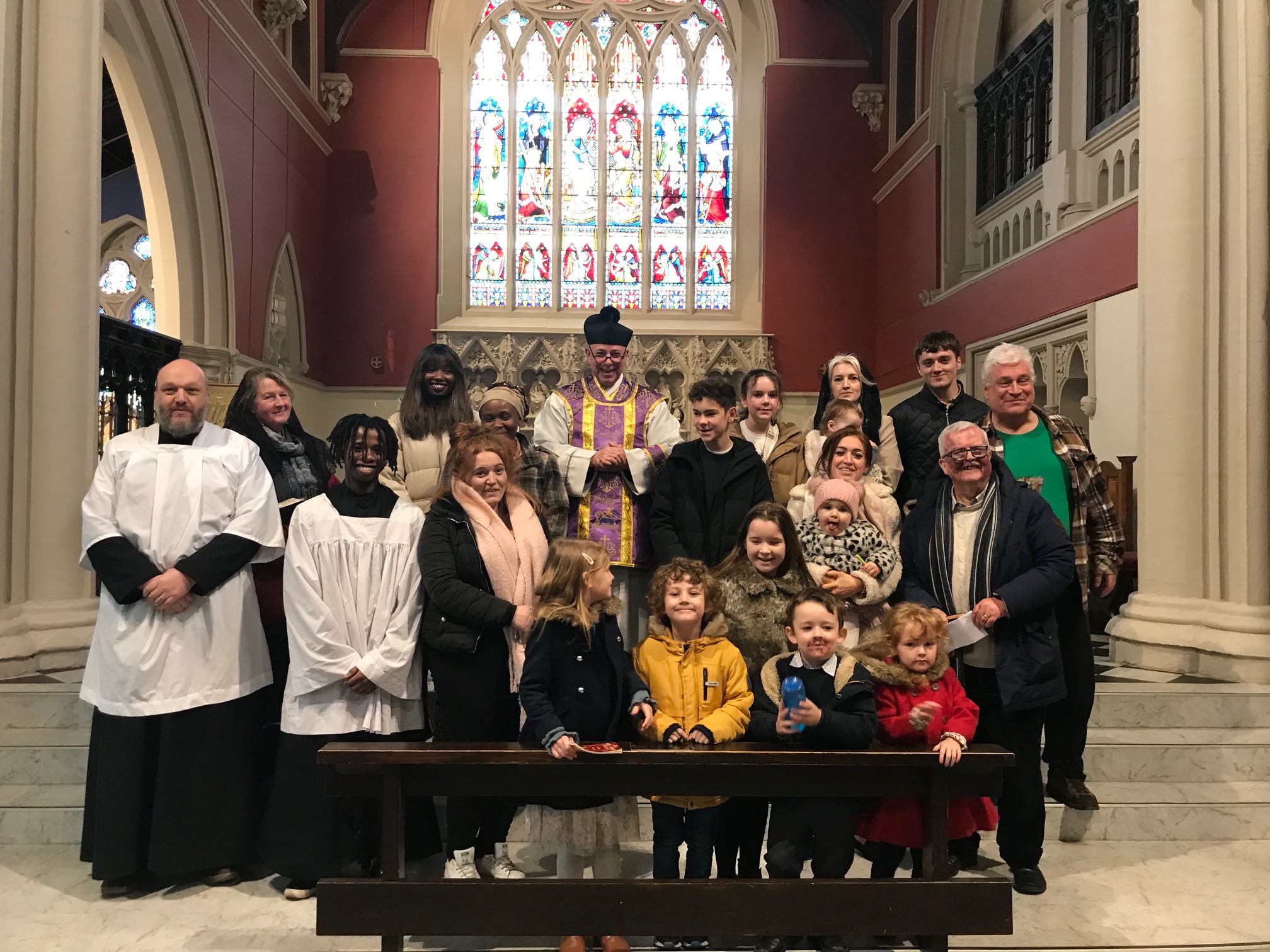
The Communications Officer took this photograph of some of the congregation with Fr. Winn following my announcement after Mass. Many people there expressed dismay at the new regulations from Rome but also their gratitude at things being able to continue as usual at St. Patrick's.
My statement about cancellation of Masses in parish churches across the diocese is sadly true.
Providentially
the bishop had already moved the celebration of the Extraordinary Form Mass
from the parish church of St. Joseph’s, Bradford to a church in the care of a
Rector who was freely appointed by him which was the redundant parish church of
St. Patrick’s, also in Bradford. The bishop did not and does not therefore need
to seek a dispensation from the Dicastery for Divine Worship and the Discipline
of the Sacraments for permission for the 1962 Missal at this church.
The norms of the Motu Proprio Traditionis Custodes state that parish churches ‘ecclesiis paroecialibus’ (Art.3 §2) may not be designated by the diocesan bishop for celebrations of Mass according to the 1962 Roman Missal for the benefit of groups of the faithful.
The bishop did, however, give temporary dispensations to some priests to continue to celebrate the old Mass in their churches within their parishes as they had done under the permission given in Pope Benedict's Summorum Pontificum.
The recent rescript from Cardinal Roche confirmed that such dispensations are now “reserved in a special way to the Apostolic See”. Consequently, in light of this latest directive those temporary permissions had to be revoked. Some, I am sure, will argue that the bishop did this with undue haste, but I know that he took this action with a view to ensuring that all current and future provision for the celebrations of Mass according to the 1962 Roman Missal in his diocese would be undertaken in accordance with the wishes of Pope Francis and the canonical faculties available to him as a diocesan bishop, and that this is the surest way of securing such future provision.
I
have spoken at length with the bishop about these changes and he assures me
that he intends to do all within his power as bishop to continue to provide for
the legitimate spiritual needs in this diocese of those groups of the faithful
who remain attached to the celebration of Mass according to the 1962 Roman
Missal.
Other than at St Patrick’s in Bradford, this may mean looking at alternative venues to the parish churches previously used in the diocese. However, he has also pointed out that it is not easy to designate existing churches as non-parochial since most of them form part of the patrimony of an existing parish and have their own juridic personality in Canon Law; nevertheless, I understand that he will be exploring all possibilities.
Ends
Saturday, February 25, 2023
Feed my sheep.
It is with a very heavy heart and no little dismay that I have to announce that Bishop Stock has, in light of the latest directives from Rome, been forced to rescind previous permissions for Masses offered in parishes across the diocese. This will take force from 27th. February.
Fortunately for us, in this diocese, the regular Masses at St. Patrick's, Westgate, Bradford WILL continue and are unaffected by this vicious new legislation. Dismay from priests who do not even offer the Traditional Mass has been palpable and I have been gratified by direct and indirect messages of support from these priests. The absurd unfairness of the whole business is a common theme in things which have been said to me. Everybody thought the liturgical wars were a thing of the past, thanks to Ratzinger's Summorum Pontificum.
I am ashamed that the author of this wicked new document is a former bishop of this diocese and I cannot help but wonder what Bishop Wheeler would have made of it.
One might have thought that driving something underground is the surest way to ensure its survival and moreover its growth, as history has shown from early Masses in the catacombs of Rome, to recusant Masses in penal times and even the very existence of Catholicism in the former Eastern bloc countries.
Bergolio's little present of 2021 in the form of Traditiones Custodes stated:
Art. 2. It belongs to the diocesan bishop, as moderator, promoter, and guardian of the whole liturgical life of the particular Church entrusted to him, [5] to regulate the liturgical celebrations of his diocese. [6] Therefore, it is his exclusive competence to authorize the use of the 1962 Roman Missal in his diocese, according to the guidelines of the Apostolic See.
Now the diocesan bishop is no longer the one able to regulate those liturgical celebrations and that he is no longer able to authorise the use of the 1962 missal according to the guidelines of the Apostolic See. Why might this be the case? Is the concept of the hermeneutic of continuity now discredited in the Nu- church? Did Bergolio and his acolytes think the bishops would jump at the chance to extirpate the old Mass from their sees and then become even more peevish when it dawned on them that most, but not all of them, actually didn't?
God help and save us!
Monday, February 20, 2023
Week beginning 20th. February
Tuesday, February 14, 2023
Week beginning 13th February
Wednesday, February 8, 2023
Week beginning 6th February
This Sunday is the second of the -gesima Sundays:
Tuesday - 6.00 p.m. St Ignatius, Ossett
Wednesday - 6.30 p.m. St. Winefride's, Wibsey
Thursday - 9.30 a.m. St Anthony's, Clayton
- 7.00 p.m. St Joseph's, Pontefract
Friday - 7.30 p.m. St. Austin's, Wakefield
Sunday - 8.30 a.m. St Ignatius, Ossett
- 1.00 p.m. St Patrick's, Bradford
Confessions at call.