Michael Rutherford's Requiem Mass details have now been finalised. It will take place at 12.30 p.m. on Friday 19th. May at the church of Saints Peter & Paul, Yeadon, Leeds, LS19 7HW followed by interment at Guiseley cemetery.
Wednesday, April 19, 2023
Monday, April 10, 2023
Thank you and update
Many thanks to those who attended this year's Sacred Triduum at St Patrick's. Similarly many thanks to Fr. Frantisek who offered the Liturgies so beautifully and to Fr. Christopher for permitting the Triduum to take place at St. Patrick's this year.
Thank you to those who have asked about, prayed for and visited David Adolph who remains in hospital. He is still very sick but it was touching to be able to converse with him yesterday after seeing him so desperately ill during the week.
I doubt that few people who attend the old Mass these days will remember Michael Rutherford who died during the night between Good Friday and Holy Saturday. Michael had been the Deputy Head at St. Michael's College in Leeds and taught the likes of Canon Timothy Wiley. and other priests of the diocese. Michael's wife, Agnes, was for many years the Representative for the Latin Mass Society in this diocese and set the tone of non-confrontation with the successors of Bishop Wheeler.
Michael who was an enormous rugby union player and fan had a very dry sense of humour and I always appreciated his candour.
As he now joins Agnes I hope and pray that he will rest in peace and rise in the glory of Almighty God. Requiescat in pace. Please remember Michael and his daughters Margaret and Alison and their families in your prayers.
Michael told me that he wished for the old Mass for his funeral and the hymn he wished to be sung at the end. I shall endeavour to carry out his wishes.


Sunday, April 9, 2023

Thursday, April 6, 2023
The Triduum

This year's Triduum will take place at St. Patrick's Church, Westgate, Bradford BD1 2RU
TIMES:
Maundy Thursday. Mass of the Lord's Supper, 7.00 p.m.
Good Friday. The Passion, 3.00 p.m.
Holy Saturday. The Easter Vigil, 7.00 p.m.
Easter Sunday. 1.00 p.m.
Of your charity
On Wednesday morning I received a telephone call from the sister of one of our regular and more eccentric attendees at St. Patrick's, David Adolph. David had been found in a collapsed state in his flat on Friday after over 24 hours. He has a bronchial infection, a kidney infection, broken ribs, a bleed to the brain and various other nasty ailments. I visited him on Wednesday afternoon after work and barely recognised him. He was unconscious and I recited the Rosary in his side ward over him. I asked the nurse to call the Catholic chaplain to administer extreme unction and I heard her ring the chaplaincy team as I was with him. It was extremely distressing. His sister is herself currently incapacitated in Surrey and so I have been his only visitor. The hospital have told his sister that he is nearing the end of his life, as the doctor also told me. Please remember David in your prayers and that the Lord relieves him of his suffering. Thank you.
Update: I have been refreshed by the goodness and concern shown by people who read the original post and have either already visited or promised to visit David. His nephew has also emailed me to thank me for the concern people have shown. David's parish priest and one of the friars from St. Patrick's have promised to visit him.
When he was conscious this morning the nurse told me he was talking about the Church and said he was clearly a strong believer in God. Please continue to pray for him.
Sunday, April 2, 2023
The Sacred Triduum 2023
This morning at Mass one of the friars came into the sacristy to speak with me. At first I thought he was going to take me to task for yesterday's April tom-foolery about votive lights thinking the friary had been berated by somebody for what I had written!
Fortunately, this wasn't the case and instead I was told that the Servant (superior) had asssented to giving Fr. Frantisek, one of our regular celebrants, permission to celebrate the Sacred Triduum for us this week.
I am, therefore, delighted to announce that this year, the first time since the pandemic, we shall again be having the Triduum in the Diocese of Leeds.
At Mass today it was announced that the Holy Thursday Mass would be at 7.30 p.m. but this has had to be changed in order to accommodate the Friars' own schedule. Apologies for any confusion caused. The definitive schedule is as follows with all services and Masses taking place at St. Patrick's church, Westgate, Bradford BD1 2RU:
Holy Thursday. Mass of the Lord's Supper. 7.00 p.m.
Good Friday. The Liturgy of the Passion and death of the Lord. 3.00 p.m.
Holy Saturday. The Paschal Vigil. 7.00 p.m.
Easter Sunday. The Resurrection of the Lord. 1.00p.m.
Please may I put on record my thanks to Fr. Christopher and Fr. Frantisek for their generosity of spirit and kindness in providing us with this grace filled opportunity.
As always and in the spirit of what Pope John Paul II gave us and what Pope Benedict XVI allowed for in Summorum Pontificum the ceremonies will be in accordance with the books in use in 1962.
Saturday, April 1, 2023
Laudato Si
This morning I received a telephone call from the Superior of the Franciscan
Friars of the Renewal, who are custodians of St. Patrick's, where we are very
fortunate to have our regular Sunday Mass. As part of their Lenten journey they
have been thinking of ways to implement more fully the Holy Father's encyclical
Laudato Si. The brothers have decided that in order to cut down on general use
of motor fuel thay will no longer be able to countenance the picking up or
delivery of votive candles for or to the church and have asked me to transmit
the message that whilst the faithful are always welcome to burn votive lamps they must
now bring their own from home and Father thanks us in advance for our
understanding in the desire to preserve the environment as (like Tesco) every
little helps. The regular attendees during the week have been given the same
message.
Fr. Joseph Falloon
Of your charity please remember the repose of the soul of Fr. Joe Falloon, aged 94, who was formerly the parish Priest at Upppermill on the very edge of the diocese. He was, before retiring to Ireland, a regular celebrant of the old Mass at Uppermill and a great character of the old school to boot. May he rest in peace. I remember him telling me that when they lived on the Falls Road in Belfast, the local bishop would sometimes call for tea and was always happy to have boiled eggs and toast or jam sandwiches and a pot of tea with the family.
Friday, March 31, 2023
Cardinal Roche to German bishops: ‘Nein’ to regular lay baptisms and preaching at Mass
I have copied and pasted the following article (in italics) from The Pillar. Cardinal Roche to German bishops: ‘Nein’ to regular lay baptisms and preaching at Mass (pillarcatholic.com)
Whilst I would obviously welcome the Cardinal's intervention, wasn't this same man who was announcing his enormous statement to the BBC less than two weeks ago that the theology of the Church has changed and that a distant priest no longer represents all people because now it is not only the priest who celebrates the liturgy but all those who are baptised with him.
Have I possibly missed something along the way? Has it not really changed or only the bits which suit a flawed and merciless agenda against the old Mass. Surely in the spirit of the Council and the now unspecified changed theology, the Church in Germany (and the Low Countries), which he admits are in decline, is taking on board what the Cardinal, presumably with the ailing Pontiff's approval, has said. I recently entered into correspondence with Frau Monika Rheinschmitt, the Treasurer of Una Voce who told me that in a country so liberal as Germany only 10% of traditional Masses have been lost since Traditiones Custodes. It appears that the implementation of the February rescript and Traditiones Custodes are the least of the Cardinal's problems in Germany. More confusion. Are we who are regarded as needing rehabilitation to be reassured by the Cardinal's words that the Vatican remains open to dialogue?
The prefect for the Vatican’s Dicastery for Divine Worship has objected to plans for regular lay baptisms and lay preaching at Masses endorsed by Germany’s controversial “synodal way.”
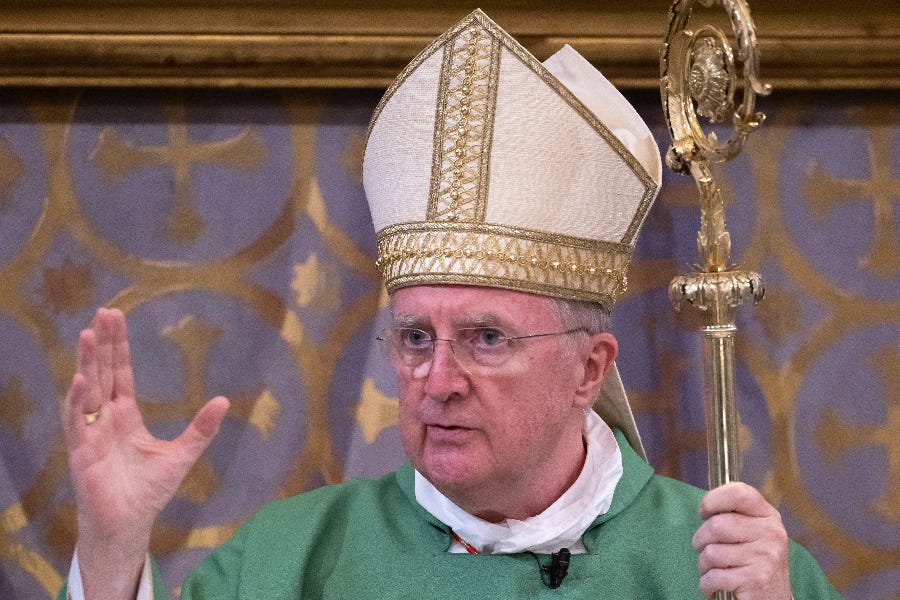
Cardinal Arthur Roche made his objections known in a letter to German bishops’ conference chairman Bishop Georg Bätzing, the official news website of the Catholic Church in Germany reported March 30.
Katholisch.de said that it had seen the letter, which had not been published by the Vatican or the German bishops’ conference at press time.
The synodal way — a three-year initiative bringing together German bishops and select lay people to discuss changes to Church teaching and practice — formally ended March 11 after approving a document entitled “Proclamation of the Gospel by lay people in word and sacrament.”
The text called on the German bishops’ conference to develop regulations “for the qualification and commissioning of lay men and women to lead the celebration of baptism.”
It also asked German bishops to “draw up a particular norm and obtain permission for this from the Holy See, according to which the homily can also be taken over in Eucharistic celebrations on Sundays and feast days by theologically and spiritually qualified faithful commissioned by the bishop.”
According to katholisch.de, Cardinal Roche referred in his letter to canon law, which says that bishops, priests, or deacons are the “ordinary ministers” of baptism, and that exceptions can only be made when they are “absent or impeded,” or “in a case of necessity.”
The prefect of the Dicastery for Divine Worship and the Discipline of the Sacraments reportedly said that the exceptions applied when an ordinary minister could not be found within a month.
He said that such conditions “do not seem to exist in any diocese in the area of the German bishops’ conference, based on the data from the papal yearbook on the clergy available.”
He added that “in any case, there were still enough ordained ministers to cope with the annual number of baptisms in the German dioceses, which is in decline.”
Regarding lay preaching, the cardinal also referred to canon law, which says that “lay persons can be permitted to preach in a church or oratory, if necessity requires it in certain circumstances or it seems advantageous in particular cases,” but the homily “is reserved to a priest or deacon.”
“This is not an exclusion of the laity,” Cardinal Roche wrote, “nor is it, of course, a denial of the right and duty of every baptized person, male or female, to proclaim the Gospel, but rather a confirmation of the specificity of this form of proclamation, which is the homily.”
He suggested that “misunderstandings about the figure and identity of the priest” could “arise in the consciousness of the Christian community” if lay people preached at Mass.
He stressed that this did not mean that there were inequalities among baptized Catholics, but rather “that there are discernments made by the Spirit, which produces different charisms that are different and complementary.”
“Word and sacrament are inseparable realities, and inasmuch as they are not merely formal expressions of the exercise of sacra potestas [sacred power], they are neither separable nor can they be separable.”
The cardinal highlighted Pope Francis’ opening in 2021 of the ministries of lector and acolyte to women.
“This openness offers lay people the opportunity to engage in meaningful liturgical ministry in the exercise of the ministry of lector and acolyte,” he wrote, expressing interest in “how this possibility was received in the dioceses in Germany.”
Both lay homilies and baptisms are already an established practice in some German dioceses. Katholisch.de noted that a 1999 document set out conditions for lay preaching at Masses in the Diocese of Rottenburg-Stuttgart. Last October, the diocese’s current Bishop Gebhard Fürst issued a decree permitting lay theologians to preside at baptisms.
Bishop Franz-Josef Overbeck of Essen formally commissioned lay people to administer baptisms in March 2022.
Cardinal Roche’s letter is the latest in a long line of Vatican interventions concerning the synodal way.
It comes little more than two weeks after Secretary of State Cardinal Pietro Parolin indicated that the Vatican opposed a synodal way resolution supporting blessings for same-sex unions in churches.
He told reporters on the sidelines of an event in Rome March 13 that “the Holy See has already expressed itself very clearly with the document of the Dicastery for the Doctrine of the Faith.” He was referring to the 2021 Vatican declaration that “the Church does not have, and cannot have, the power to bless unions of persons of the same sex.”
Cardinal Roche reportedly ended his letter to Bishop Bätzing by underlining that the Vatican remained open to dialogue.
A spokesman for Germany’s bishops’ conference told katholisch.de: “We realize that the dicastery’s letter describes the current situation on the issues discussed. At the end, there is an invitation to further dialogue, which we are happy to accept. It’s good that we’re staying in touch with Rome in this way.”
A spokeswoman for the powerful lay Central Committee of German Catholics (ZdK) told the website that the Vatican letter was a welcome sign of Rome’s interest in the consequences of the synodal way in Germany.
“Talks in Rome are overdue and are in the heartfelt interest of Catholic civil society in this country,” said Britta Baas.
She added: “In just a few years, no one will be able to seriously oppose lay sermons and baptisms by lay people if the Church still wants to have meaning for the local people. We already have a glaring shortage of priests.”
Thursday, March 30, 2023
Very recent strong words from the Archbishop Emeritus of La Plata, Buenos Aires, Argentina
I celebrated my first Mass on November 26, 1972. I did it using the rite then in force, the one created by Paul VI, whose author was the Freemason Annibale Bugnini. The Mass was In Spanish, of course, though the secret prayers of the celebrant survived in Latin.
It had never occurred to me to resort to the "Mass of the Ages." The one we prayed at the Seminary every year of my formation, with the novelty that it was -- in the chapel of the philosophate, daily -- and versus populum. It never occurred to me to resort -- contrary to the prohibition that had been peacefully accepted -- to the old form. Not even after Benedict XVI accepted it as an extraordinary form of the Roman Rite by means of his motu proprio Summorum Pontificum.In spite of my theological and liturgical studies, which gave me a lucid understanding of the forgotten ritual, no ideological objections or nostalgia were imposed on me; the tradition was shelved, and perhaps out of laziness I did not dare to contradict it by critically judging the novelty that followed Vatican II.
Today, I think that Paul VI could have made some modifications to update the Mass of the Ages, which had been in force for centuries, rather than inventing a new rite of Mass. Objectively, I can measure the audacity of the new rite, an unexpected boast for many of progressivism; many centuries were discarded, thrown away in the whirlwind of changes.
I have appealed to this personal history to emphasize that I am free in my judgment: I continue to celebrate the Mass of Paul VI. This ecclesial position, however, allows me to gauge the damage done by the motu proprio Traditiones Custodes, recently reinforced by a "rescript".
Rome should ask itself why more and more priests and laity -- the latter above all -- are inclined, with veneration, toward the ancient rite. The anti-liturgical obsession is an ideology that canonically becomes a tyranny. Indeed, the prohibition of the Missal of John XXIII is not taken into account by young people, who aspire to a worship that responds to the truth of faith: worship of God, not of man. Rome, for its part, continues to cling to Karl Rahner's die anthropologische Wende (anthropological turn).
In the last decade, moreover, the aliturgical tradition of the Society of Jesus has come into play. The displacement of the liturgy gives rise to the imposition, in word and deed, of a relativistic moralism.
Anti-liturgical innovations have followed one another without interruption since the promulgation of the "new Mass". This new beginning signaled an unnecessary change. The Second Vatican Council's purpose of renewal could have been accomplished with slight modifications of the existing Roman Rite, or rather, with correction of the alterations produced in history. The conciliar purpose was significantly called instauratio, that is, restoration.
Crude dissidence arose from the 1970s onwards, in the face of Rome's stubbornness to hold to the new. Benedict XVI, by means of his motu proprio Summorum Pontificum, liberalized the extraordinary form of the Roman Rite; it was a Solomonic solution that could satisfy the aspirations of priests and faithful attached to Tradition, and at the same time give a solid foundation for the objections directed against the Mass promulgated by Paul VI.
This prudent and pastoral sensitivity allowed us to hope for a stable peace, with the return to obedience of numerous communities that lived in conflict with Rome. It is true that the differences with Vatican II went far beyond the liturgical order and extended to the doctrinal and juridical-pastoral field. The liturgical magisterium of the German Pope took up the theology of the liturgy developed by Cardinal Ratzinger, who followed in the footsteps of Romano Guardini and Klaus Gamber.
In light of all this, an unfortunate setback occurred with the motu proprio Traditiones Custodes, which eliminated the extraordinary form of the Roman Rite and imposed sharp conditions for granting the use of the Mass of the Ages. From this perspective, one can newly appreciate the gravity of Paul VI's actions, which initiated a new stage in all areas of ecclesial life, and gave room in the post-conciliar period for errors and mutilations worse than those sustained by the modernism of the early 20th century, condemned by St. Pius X.
The line opened by Francis's motu proprio has recently been ratified and aggravated by a "rescript" that imposes on bishops the obligation to obtain the pontifical placet before authorizing the use of the Mass of the Ages. This implausible imposition undermines the much-vaunted "synodality"; the authority of the bishops has been curtailed in an essential area of their munus as Successors of the Apostles.
It is to be feared that this antiliturgical pertinacity will once again give rise to attitudes contrary to the "unity" that Rome claims to profess. From the same source comes -- it seems to me -- the illusion of an ecclesial reform, which would have been requested by the conclave that elected the current pope. The Society of Jesus has always been a force for the reentrenchment of the Church in society, in competition with Freemasonry. The Vatican today, however, is full of Freemasons, and the pope tries to make use of them. I find wonderfully surprising the Pope's complacency in his decade of government, and the fiction of attributing successes to his collaborators; but a chronic problem of the Society has been that of humility.
Aliturgicism includes the devastation of what comes from Tradition in the liturgy of the Roman Rite. The antiliturgical obsession, which I have already mentioned, goes to the extreme of boycotting synodality. A bishop, in order to authorize a priest to celebrate with the Missal of John XXIII -- that is, the Mass of the Ages -- needs to ask permission from Rome. Such is the tenor of the recent rescriptum: a true pontifical tyranny that disqualifies the successors of the apostles from fulfilling their ministry in such a fundamental matter.
This new orientation allows the devastation of the liturgy [i.e., the Novus Ordo] to go forward with impunity. Again, I will mention that this freedom contradicts what the Council prescribes, in the Constitution on the Liturgy Sacrosanctum Concilium, namely, that no one, even if a priest, should change, add to, or subtract from the liturgical rites on his own initiative. The freedom of devastation goes hand in hand with the persecution of traditionalists.
A flagrant contradiction: traditionalists are persecuted, but the integration into the Roman Rite of percussive and dancing rhythms and the adoption of pagan, Hindu, or Buddhist rites, according to the principles of the New World Order vying with Freemasonry, is consented to. In visits to various nations, it is deemed acceptable to introduced into the liturgy tribal rites of the ancestral culture of the visited peoples. Thus, the deformation of divine worship borders on idolatry.
This attitude is repeated in many countries, as a perversion of interreligious dialogue. In 2019, the Pope signed in Abu Dhabi the Document on Human Brotherhood for World Peace and Common Coexistence, in which it is said: "Pluralism and diversity of religion, color, sex, race and language are a wise divine will, by which God created human beings. This divine Wisdom is the origin from which derives the right to freedom of belief and the freedom to be different." God the Creator would then be the author of polytheism!
This affirmation is tantamount to renouncing the essential and original mission of the Church, as expressly stated in the Gospel: "Go into all the world and preach the Gospel to every creature. He who believes and is baptized will be saved, but he who does not believe will be condemned" (Mk 16:15-16). Such a renunciation can only be seen as apostasy.
The same attitude is found in 2020, in the acceptance of the proposal for a day of prayer and fasting of all religions on May 14. The Pontiff referred to the acceptance of the proposal: "I have accepted the proposal of the High Committee for Human Fraternity that next May 14 the believers of all religions unite spiritually in a day of prayer and fasting and works of charity." It is evident in this way that the Church ignores its original mission of announcing the Gospel of salvation and joins the world polytheistic concert, thus participating, as one of the religions in the New World Order advocated by Freemasonry. This would not be possible if the Vatican were not already infiltrated by Freemasonry. From this perspective, the incorporation of pagan rites into the liturgy can be understood. It also explains the persecution of the traditionalists, who by their refusal hinder the full insertion of the Church into this New World Order; thus the Church is heading towards the reign of the Antichrist. The confusion of the believers is the consequence; it is the mysterium iniquitatis deployed by the devil.
The Abu Dhabi document implies the apostasy of the Catholic faith to adhere -- as I have already written -- to the New World Order. There is no compatibility between the latter and the Christian faith; the confusion into which believers are thrown could not be greater. This contrast appears in every intervention of the Pontiff, which proves that this is how he understands the mission of the Church, and this is how his task of government is understood.
A very clear example is found in the letter addressed to him by Argentine politicians on the occasion of the tenth anniversary of his pontificate: "We wish to express our admiration for your work in favor of Humanity [thus, with a capital letter in the original], in particular, of excluded persons and poor peoples, your firm defense of world peace and your permanent promotion of an integral Ecology [the capital letter in the original], which allows us to hear the cry of Mother Earth and of the Human Being [polytheistic and Masonic language] in the face of destructive situations that threaten peoples and nature."
In this context, the anti-liturgical passion against the "Mass of the Ages," in which the true faith in and coherence with the will of Jesus Christ and the traditional mission of the Church shines with clarity, is explained.
A new understanding of synodality is now insinuated: if a bishop wants to authorize a priest to celebrate the ancient Mass, he must ask Rome's permission. We are dealing here with an obsession that no longer has bounds.
+ Hector Aguer
Archbishop Emeritus of La Plata
Buenos Aires
March 30, 2023
Tuesday, March 28, 2023
Poster Campaign in Rome
Text copied from Gateshead Revisited blog:

News from Rome! http://blog.messainlatino.it/2023/03/breakingnews-la-liturgia-tradizionale.html
PRESS RELEASE Starting this morning, and lasting for 15 days, several dozen billboards dedicated to the traditional liturgy will be posted near and around the Vatican. An organizing committee, whose members are participating in a personal capacity and who come from different Catholic entities (such as the blogs, Messainlatino and Campari & de Maistre, and the associations, National Committee on Summorum Pontificum and the St Michael the Archangel Association), wished to make public their profound attachment to the traditional Mass at a time when its extinction seems to be planned. They do so out of love for the Pope, so that he might be paternally opened to understanding those liturgical peripheries that no longer feel welcome in the Church, because they find in the traditional liturgy the full and complete expression of the entire Catholic Faith. “What earlier generations held as sacred, remains sacred and great for us too, and it cannot be all of a sudden entirely forbidden of even considered harmful” (Benedict XVI, Letter to the Bishops on the occasion of the publication of the Apostolic Letter Summorum Pontificum). The growing hostility towards the traditional liturgy finds no justification on either a theological or pastoral level. The communities that celebrate the liturgy according to the 1962 Roman Missal are not rebels against the Church. On the contrary, blessed by steady growth in lay faithful and priestly vocations, they constitute an example of steadfast perseverance in Catholic faith and unity, in a world increasingly insensitive to the Gospel, and an ecclesial context increasingly yielding to disintegrating impulses. For this reason, the attitude of rejection with which their own pastors are forced to treat these communities today is not only reason for bitter sorrow, which these faithful strive to offer for the purification of the Church, but also constitutes a grave injustice. In the face of this injustice, charity itself demands that we not remain silent: for “indiscreet silence leaves in error those who might have been instructed” (Pope St Gregory the Great, Pastoral Rule, Book II, chapter 4). In the Church of our day, in which listening, welcoming, and inclusion inspire all pastoral action, and there is a desire to build ecclesial communion “with a synodal method,” this group of ordinary faithful, young families, and fervent priests has the confident hope that its voice will not be stifled but welcomed, listened to, and taken into due consideration. Those who go to the “Latin Mass” are not second-class believers, nor are they deviants to be re-educated or a burden to be gotten rid of. The Organizing Committee (Toni Brandi, Luigi Casalini, Federico Catani, Guillaume Luyt, Simone Ortolani, Marco Sgroi) prolibertatemissalis@gmail.com
Saturday, March 25, 2023
A “rite” to reply.
I had been told beforehand that this diocese’s episcopal delegate for the traditional Mass, Fr. Michael
Hall, had been interviewed for March 19th.’s Sunday programme in a piece about
the Roche Rescript. (It is available here: Sunday - 19/03/2023 - BBC
Sounds at 5:10 into the programme). It was a short report and featured
Father Hall, a south of England You-Tuber, Austin Ivereigh and Cardinal Roche
himself.
The whole thing made for sad and
disturbing listening as Fr. Hall explained that he didn’t feel as if he could really
look to the Holy Father as his spiritual father because of things he had said
about traditional Catholics and that he felt as if Francis hates him and people
like him.
An internet search of remarks
made by the Pope about those attracted to the old Mass would certainly bear
this out. “Restorationism has come to gag the Council”; their problem is
“precisely their non-acceptance of the Council”; “Dogma and morality is always
in a path of development”; “You cannot do theology with a ‘no’ in front of it;
“Tradition is the living faith of the dead, for traditionalists it is the dead
faith of the living”; “'Self-absorbed neo-Promethean Pelagians”; “Traditionalists
safeguard the ashes of the past whilst ‘touting’ tradition as the guarantee of
the future”.
Thus, it seems we have been cast
as prostitutes looking for business.
Perhaps most tellingly on June 14th. 2022, the Jesuit publication America
reported, “Just last week, in a meeting with Sicilian clergy, Francis told the
priests that it wasn’t always appropriate to use “grandma’s lace” in their
vestments and to update their liturgical garb to be in touch with
current times and follow in
the spirit of Vatican II.”
These remarks were also echoed in the Sunday broadcast by Cardinal Roche who claimed that the theology of the Church has changed and that a distant priest no longer represents all people because now it is not only the priest who celebrates the liturgy but all those who are baptised with him.
The Cardinal
admitted that this was an enormous statement to make.
My understanding had been that
pastors were to ensure “the faithful were fully aware of what they were doing,
actively engaged in the rite, and enriched by it.” (Sacrosanctum Concillium.) In
anybody’s wildest imaginings this could not mean that they were to be eventually
regarded as concelebrants. Could it?
The enormity of the statement is
undeniable for nowhere in the documents of the Council have I ever seen or had
my attention drawn to such a statement. Is the Cardinal perhaps referring to
what Pope Francis above calls the spirit of the Council?
I am assuming that this “spirit”
permits the abomination of idol worship in the figure of the Pachamama?
Pachamama (Earth Mother) is a goddess revered by people of the Andes and is
also an Earth Mother in Inca mythology who is a fertility goddess who oversees
planting and harvesting and is able to cause earthquakes. As an ever-present
and independent “deity”, she apparently has the power to sustain life on earth.

The Holy Father with Pachamama in
the foreground in the Vatican gardens
Perhaps the spirit of the Council
is the permission for those living in irregular situations to avail themselves
of the reception of Holy Communion by way of a discursive footnote in the document
Amoris Laetitia. To me this makes a mockery of the heroic struggles made by people in irregular relationships both now and in the past to live up to the Teaching of the Church in regard to this matter.
I repeat, “The theology of the
Church has changed”, according to Cardinal Roche. Do we have evidence of this
statement yet?
Cardinal Hollerich SJ the Primate
of Luxembourg who is the Relator General of Pope Francis’ Synod stated with
regard to the Synod, “We must learn to cope with multiple expressions of faith.
Today one can no longer proscribe a single practice, nor can we as bishops.”
Spoken like a true liberal. I have been unable to ascertain the situation
facing the old Mass in Luxembourg.
This very much reminds me of
comments made to me by Bishop Terry Drainey a few years ago at the Oratory in
York. He said that there could be no problem if people genuinely worshipped God
by attending a Solemn High Mass or standing on a chair waving their arms in the
air. More likely to do the former myself, I couldn’t disagree with him. I know a lot of
good arm wavers and have known many Charismatics who were as devoted and
obedient to the traditional teaching of the Church as any traditionally
orientated Catholic I have known.
It has been pointed out countless
times by people far more intelligent than I am that the strength of the unity
of the Church is in its diversity and not in uniformity and rigidity. There are 24 Rites and Uses in the Church. Is
Cardinal Roche’s intention to kick these venerable Rites into line with his
vision of Nu-church with its new theology by picking them off one at a time
starting, say with the Ordinariate Use with the excuse that if they really want
to be Catholics they’ll have to start singing from the same hymn sheet?
It certainly looks as if what the
Pope and the Cardinal are saying is that the Traditional Mass, the
Extraordinary Form, is no longer compatible with the spirit of Vatican II.
In his slot on the Sunday
Programme Mr. Ivereigh said that it was very clear in the Pope’s letter to the
bishops that traditionalists represent a movement to undermine Vatican II. He
wishes not to suppress the old Mass but to regulate it by putting it back into
the hands of the bishops.
I wondered if this clip of Mr.
Ivereigh referred to Traditiones Custodes and not the Roche Rescript as the
rescript has done exactly the opposite to what the pope appeared to have
originally intended.
Cardinal Roche’s Rescript
snatches away the power of the bishops to “regulate” the celebration of Mass in
their respective dioceses according to the books of 1962. Cardinal Roche is as
keen to remind us of the Council as the Pope is to have us kowtow to its spirit
but the Council’s document Lumen Gentium (27) stopped the bishops from being
mere vicars or lackeys of the pope by stating, “bishops have the sacred right
and duty before the Lord…to moderate everything
pertaining to the ordering of worship.” To all intents and purposes Church
teaching from as late as the 1960s is now being sacrificed on the altar of the “hermeneutic
of discontinuity and rupture” in the mere name of the spirit of the
Council. Confusion reigns. Who is undermining the Council now? Goodbye to the
concept of collegiality.
Pope John XXIII who convoked the
Council said its primary purpose was that the sacred deposit of Christian
Doctrine be guarded and taught more effectively. At its close Pope Paul
VI said that John's great purpose had been achieved. There was apparently never
any intention of new theology.
In Traditiones Custodes
the Pope begins by stating, “Guardians of the Tradition, the bishops in
communion with the bishop of Rome constitute the visible principle and
foundation of the unity of their particular churches. Under the guidance of the
Holy Spirit through the proclamation of the Gospel and by means of the
celebration of the Eucharist they govern the particular churches entrusted to
them”.
He goes on to say that his
predecessors John Paul II and Benedict XVI granted and regulated the faculty to
use the Roman Missal edited by John XXIII in 1962 to facilitate the ecclesial
communion of those Catholics who feel attached to some earlier liturgical form.
In 2020 there was a consultation
of the bishops and apparently as a result of this “consultation” , the results of which, in our open Church, have never
been revealed, the pope imposed a list
of restrictions in Traditiones Custodes decreeing for example that there
should be no authorisation of establishing new groups and that no priest
ordained after the publication of that document should be allowed to offer the
traditional Mass without recourse to Rome for this permission. I wonder how
many priests have requested and been granted such permission.
Bishops as the guardians of tradition
were now free to dispense with permitting the celebration of Mass according to
the books of 1962 if they so wished. Some like Cardinal Cupich of Chicago and
others did use this document to axe Masses but by and large most bishops were
happy to allow the status quo to continue in their sees. Very strange if the bishop’s
consultation had hinted at widespread disobedience and sedition against the
Council. Liturgical peace was shattered in such places as old wounds were
reopened and now fester again.
Some bishops posed dubia and in
his responsa, Cardinal Roche added further restrictions saying for example that
celebrations of the 1962 Mass were not allowed to be advertised on parish
bulletins and newsletters.
Possibly in reaction to the fact
that the bishops had in effect generally ignored Traditiones Custodes it
came as no surprise when the Congregation for Divine Liturgy and Discipline of
the Sacraments published the shocking rescript in February of this year which
knuckled down on what had gone before it by further attempting to stamp out the
old Mass. Under canon 87 (i) a bishop, remember, a custodian of tradition whose
duty it is to moderate everything pertaining to the ordering of worship now had
the rug pulled from under his feet as this right in canon law was withdrawn Is the Code of
Canon Law so delicate that one Prefect can sweep it away so swiftly? The permissions
given by bishops in their own dioceses to their priests saying the old Mass in
their parish churches and chapels were nullified by the stroke of a pen. Bishops
were being expected to dust off their liturgical jackboots.
In one conversation I had with
Bishop Stock he told me that he knew well enough that there were no seditious
groups lurking in the wings to question and undermine the Council. Indeed, few
of the priests who offer the Mass in this diocese are even hardly old enough to
remember it and they all say the new Mass dutifully without murmuring or
rancour. Why should they? One Leeds parish priest told me that by celebrating
the old Mass privately it had enriched his experience of saying the new Mass
and deepened his understanding of it.
Perhaps Pope Benedict saw the
dangers of where the nebulous spirit of the Council was leading when as early
as 1990 he wrote, “The liturgical reform in its concrete realization has
distanced itself even more from its origin. The result has not been a
re-animation but devastation – they have produced a fabricated liturgy.” (Revue
Theologisches)
In 2000 in his Spirit of the
Liturgy, “Anyone who now advocates the continuing existence of this liturgy
or takes part in it is treated like a leper. All tolerance ends here. In doing
this we are despising and proscribing the Church’s whole past. How can one
trust her at present if things are that way?
He had already decried this
attitude in 1997 in his Salt of the Earth as being “downright indecent”.
Ratzinger’s predecessor Pope John
Paul II wrote in 1988, “The souls of those who feel bound to the Latin
liturgical tradition must be respected everywhere through a broad and generous
application of the directives already issued by the Holy See for the use of the
Roman Missal according to the typical edition of 1962.”
The week before on the Sunday
programme Cardinal Roche had spoken about the role of priests who the pope had
said needed to have the smell of the sheep. It would now appear that this
doesn’t apply if those souls smell of the old Mass or grandma’s lace. The
journalist at the BBC made reference to women attendees at the old Mass wearing
mantillas.
Instead, the spirit of Vatican II
has now opened up another can of worms with the ongoing synodal process. The
German Church has voted to adopt “implementation texts” related to same-sex
blessings, lay preaching during Mass and other controversial issues. These two former
things are explicitly forbidden at the moment, but I haven’t heard much, if any
condemnation from Rome since the majority of German bishops voted for these
things. I suppose now in Germany if I were a gay Catholic who wanted my civil
partnership blessing and to celebrate it with a traditional Mass I would get
the blessing but not the Mass. It beggars belief.
Who knows where the synodal path
will lead? It seems that the new “theology” will manifest itself in time but I
do know that Christ never told Peter that he was the rock on which He would
build his synodal cafeteria Church. It very much looks as if this confusing
papacy of mercy and decentralisation is as totally merciless and centralising
as one could imagine for a persecuted minority of faithful souls. Pastoral
sensitivity is really a thing of the past for some but there is always the
danger that this marginalisation and persecution of some of these people of God
will backfire and lead to increased devotion to the Mass which nourished so
many Catholics in times of persecution over the centuries. Nobody has succeeded
in stamping it out yet. Perhaps Vatican III is in the not too distant future.
Indeed, what greater comfort
could there be when in Psalm 42 at the start of most Masses the priest says,
“Do me justice, O God, and fight my fight against a faithless people; from the
deceitful and impious man rescue me”. Never has this psalm’s verse been so
resonant.
Cardinal McElroy has called for radical inclusion of marginalised groups in a very different context and certainly not our context. I feel as if I am part of a such a group these days and I want, like Fr. Hall to feel included in the Church I love.
My fear is that the beatings will
continue until morale improves.

I have recently made contact with a gentleman who lives near
Bradford who has started attending our Sunday Masses at St. Patrick’s.
He is a family man called Aidan Hargitt and he holds an MA
(Oxon) in Classics, an MA in Theological Research from Durham University and an
M.Litt (two years research) degree in Theology (Ecclesiastical History), also
from Durham.
He is keen to offer assistance with translation or to give
lessons to any clergy, religious or laity who wanted to learn or improve their
knowledge of Latin and Greek, or to provide assistance to local Catholic
schools in some way. He also offers French.
Should any reader of this blog wish to avail themselves of
Aidan’s wide ranging services he is available for online tuition &c and for
details of terms and conditions he may be reached at aidan.hargitt@gmail.com
Monday, March 13, 2023
From the Catholic Herald
Letter from Rome: the Roche rescript comes with all the zeal of Saul the Pharisee

Cardinal Arthur Roche, prefect of the Dicastery for Divine Worship and the Discipline of the Sacraments
(Photo: Marcin Mazur)
VATICAN CITY
Still breathing threats against the Church’s ancient liturgy in a way not unlike Saul’s persecution in Acts 9:1, Cardinal Arthur Roche has now begun strong-arming bishops to “ensure the correct application” of Pope Francis’s 2021 apostolic letter restricting the Traditional Latin Mass (TLM), Traditionis Custodes.
The latest crackdown by the prefect of the Dicastery for Divine Worship and the Discipline of the Sacraments has come in a rescript that severely restricts the freedom of bishops in matters of the TLM and their autonomy as “directors, promoters, and guardians of the entire liturgical life” in their dioceses (Canon 835 §1).
The 21 February rescript, signed by Cardinal Roche, and approved by Pope Francis during a private audience one day prior, states that the Pope has confirmed that diocesan bishops must obtain permission from the Dicastery for Divine Worship to use a parish church in their diocese for the TLM, erect a personal parish for the celebration of the usus antiquor, or allow a newly-ordained priest to offer Mass using the 1962 Roman Missal.
Pope Francis has also decided that bishops who up to now have exercised their dispensing authority (given to them in Canon 87 §1) must inform the Dicastery for Divine Worship which will decide either to affirm or overrule those decisions.
The rescript became an urgent necessity for Cardinal Roche amid growing opposition to his crackdown on the traditional liturgy, continuing resistance from bishops to his desired implementation of Traditionis Custodes, and mounting criticism from canonists that he had been exceeding his remit and venturing into canonical lawlessness.
Letters and Lawlessness?
Since December, Cardinal Roche has been sending letters to US bishops who had cited Canon 87 §1 of the Code of Canon Law as their reason for not asking permission from Rome to allow the Traditional Latin Mass in parish churches. That canon stipulates that a bishop may dispense the faithful from “universal and particular disciplinary laws” (eg certain provisions of Traditionis Custodes) when he judges it to be for their spiritual good.
In one of these letters, sent to a bishop in California, Cardinal Roche insisted that his dicastery alone had the power to dispense from the provisions of Traditionis Custodes to allow a parish church to be used for the TLM. The same holds true, he said, for granting permission to a newly-ordained priest to offer the Mass using the 1962 Missal.
Cardinal Roche also stipulated in this letter that, should the bishop petition the dicastery for a dispensation to allow the TLM in a parish church, he must submit a report detailing “the number of participants at these Masses” and recounting “the steps being taken to lead the faithful who are attached to the antecedent liturgy” to the Novus Ordo.
The letters reiterated several of the disciplinary instructions Cardinal Roche had issued a year prior in his Responsa ad dubia (on applying Traditionis Custodes) but which many bishops had not implemented and which a number of canon lawyers have described as an overreach.
In an interview following the release of the Responsa, New York canonist Father Gerald Murray argued that the document went beyond what was canonically possible on certain points and that bishops were free to dispense with its disciplinary provisions for the spiritual welfare of their flock.
Cardinal Roche’s more recent letters were therefore a further attempt to tighten the screws, but canonists continued to maintain that bishops did not need to petition Rome for a dispensation to allow the TLM to be celebrated in parish churches.
In comments to the Catholic Herald before the rescript was issued, Fr Murray noted that Cardinal Roche “seems to presume that the diocesan bishop lacks the power to dispense from this rule, which power is granted to him by Canon 87 §1, because he seems to presume that such dispensation has been reserved to the Holy See.”
“The problem with this claim,” Fr Murray said, “is that nowhere does Traditionis Custodes state that dispensation from the prohibition of allowing the use of a parish church is reserved to the Holy See.”
He continued: “The provisions of Canon 87 §1 that permit the diocesan bishop, for reasons of ‘spiritual welfare,’ to dispense from disciplinary ‘universal laws and those particular laws made by the supreme ecclesiastical authority for his territory or his subjects’ remain in place unless the Pope specifically reserves such dispensation to himself or to some other authority. No such reservation is stated in Traditionis Custodes nor in the Responsa.”
Fr Murray also explained that “for a newly-ordained priest to obtain authorization from his bishop to celebrate the Traditional Latin Mass, the promulgated Italian text of Traditionis Custodes states that the bishop is simply required to ‘consult’ with the Holy See. The later official Latin translation of Traditionis Custodes [whose existence was unknown until Cardinal Roche issued the Responsa] changed the wording to say that the bishop must ‘ask for permission’ from the Holy See to give such an authorization.”
“This substantive change in law carried out through an unannounced changing of the original wording when producing a translation is most irregular,” the canonist observed.
Noting that the English, Italian and Spanish versions of Traditionis Custodes on the Holy See website still do not include the change found in the Latin version, Fr Murray said “this confusion and inconsistency can give rise to a doubt that this changed provision enjoys legal force. An Apostolic Letter is not subject to re-writing by a translator unless the change is specifically authorized and promulgated by the Pope. There is no evidence that this occurred in the case of the Latin translation.” Other canonists have made similar arguments.
To overcome his opposition and forge ahead in laying waste to the Church’s ancient rites, Cardinal Roche needed to convince Pope Francis to put into legislation what he had been trying to enforce without proper canonical backing: hence the rescript.
Operation Rescript
In comments to the Catholic Herald on the day the rescript was issued, Fr Murray insisted it was “evidence that Cardinal Roche understood that reasonable doubts existed about his claim that bishops could not dispense various provisions of Traditionis Custodes using Canon 87 §1.”
He observed: “The rescript states that Pope Francis ‘has confirmed’ three things ‘about the implementation of his motu proprio Traditionis Custodes’ which were not stated in Traditionis Custodes; namely, that only the Holy See can grant permission to newly ordained priests to celebrate the Traditional Latin Mass, that diocesan bishops cannot dispense from the prohibition of a parish church being used for the celebration of the Traditional Latin Mass, and that they cannot dispense from the prohibition of the erection of personal parishes for such celebrations.”
Fr Murray noted that this new legislation “further withdraws from diocesan bishops their ordinary power to decide the most pastorally beneficial approach to take in these matters.” And he called it “regrettable” as “both a diminution of the pastoral authority of bishops and as an unmistakable sign that the Holy Father has decided that Catholics attached to the ancient liturgical heritage of the Church do not deserve the same place in the Church as the other faithful.”
“Banishment from parishes and restrictions on young priests who would like to be of pastoral service are harsh and repressive measures which are undeserved and manifestly contrary to the Pope’s call for going out to the peripheries,” he said. Meanwhile, a source close to the Dicastery for Divine Worship has confirmed to the Catholic Herald that no permissions have or will be granted to priests ordained since Traditionis Custodes.
Appearing on The World Over on Thursday, 23 February, Fr Murray summed up the situation, saying: “It’s a persecution of Latin Mass Catholics, plain and simple. And it can’t be justified by saying this is going to help promote the mission of the Church. This is damaging the Church.”
One question that arises is how the dicastery will enforce the rescript given its severely limited resources? Will Cardinal Roche himself “enter house after house” to banish traditional Catholics from their spiritual home?
Reports have it that the prefect has sought an Apostolic Constitution with still more sweeping measures against the traditional Roman Rite. Whether this recent act is a more limited response to this alleged request, or a foretaste of more to come, only time will tell.
But another and perhaps more pressing question is why Cardinal Roche needs to exert such pressure on diocesan bishops, when the majority were – supposedly – unhappy with the application of Benedict XVI’s Summorum Pontificum.
Pope Francis said in Traditionis Custodes that “the wishes expressed by the episcopate” in a consultation of bishops, carried out in 2020 by the Congregation for the Doctrine of the Faith, called for a crackdown on the traditional Latin liturgy. And in his accompanying letter to the motu proprio, he said that he was “responding to [their] requests.”
The Vatican never disclosed the results of this consultation, something which “remained mysterious” even to Pope Emeritus Benedict himself.
Extensive leaks of the 2020 consultation have appeared, however, and seem to tell a rather different story about episcopal reaction to Benedict XVI’s 2007 motu proprio, with many testimonies to its fruitfulness and the peace it achieved. In fact, they revealed that the message from the majority of bishops was to continue with a prudent and careful application of Summorum Pontificum.
Questions of ecclesiastical prudence are never for the faint hearted, but in the present case it might be worth recalling the warning of Saul’s own teacher, Gamaliel, to the Sanhedrin in Acts 5:39: “If it is of God, you will not be able to overthrow them. You might even be found to be opposing God.”
Subscribe to:
Posts (Atom)